


Back in the early days of Facebook Ads—when right-hand column placements were king and interest targeting felt like a cheat code—I was already running campaigns with clients asking me the same thing: “Why aren’t we scaling?”
I had to learn fast. I didn’t just figure out how to get cheap clicks. I had to learn how to make Facebook Ads work—for real businesses, with real expectations, and not a lot of patience.
Years later, leading performance teams at Dream Media, I found myself on the other side: teaching others how to think strategically inside the Meta ecosystem. Not how to hit “Boost” or follow recycled advice. But how to build Facebook campaigns that actually drive revenue, leads, booked calls, and customer loyalty.
This is how I train Facebook Ads specialists today—pulling from decades of wins, plenty of losses, and systems that scale beyond gut instinct. Story-driven. Long-winded. Personal. Because that’s the way I lead.

Start With Psychology, Not Platforms
When someone joins my team, we don’t dive into Ads Manager on Day 1. We talk about why people scroll. I ask them to pull out their phones and open their feed. I say, “Scroll like you normally do. Now stop. What made you pause?”
Then I ask:
- What do you stop for in your own feed?
- Why do some posts feel like noise and others make you click?
- What’s the difference between interruption and invitation?
These seem like simple questions, but they open up real insights about consumer behavior. Facebook isn’t a search engine. People aren’t typing in what they want—they’re grazing, they’re passive, they’re reacting to pattern breaks and emotion. If you don’t understand that, no amount of targeting or bidding will fix your results.
A mistake I made early on was hiring media buyers who knew every optimization toggle but didn’t get people. They built campaigns that looked great in dashboards but didn’t move a single dollar. They’d tweak bids, fiddle with budgets, and ask for more creative—but they weren’t thinking about what the person on the other side of the ad needed to see, feel, or hear.
So now I screen for instinct and curiosity about human behavior. I’ll take someone who knows storytelling over someone who’s memorized every placement type. The best Facebook marketers I’ve trained are the ones who ask, “What story are we telling, and to whom?” before they touch the budget settings.
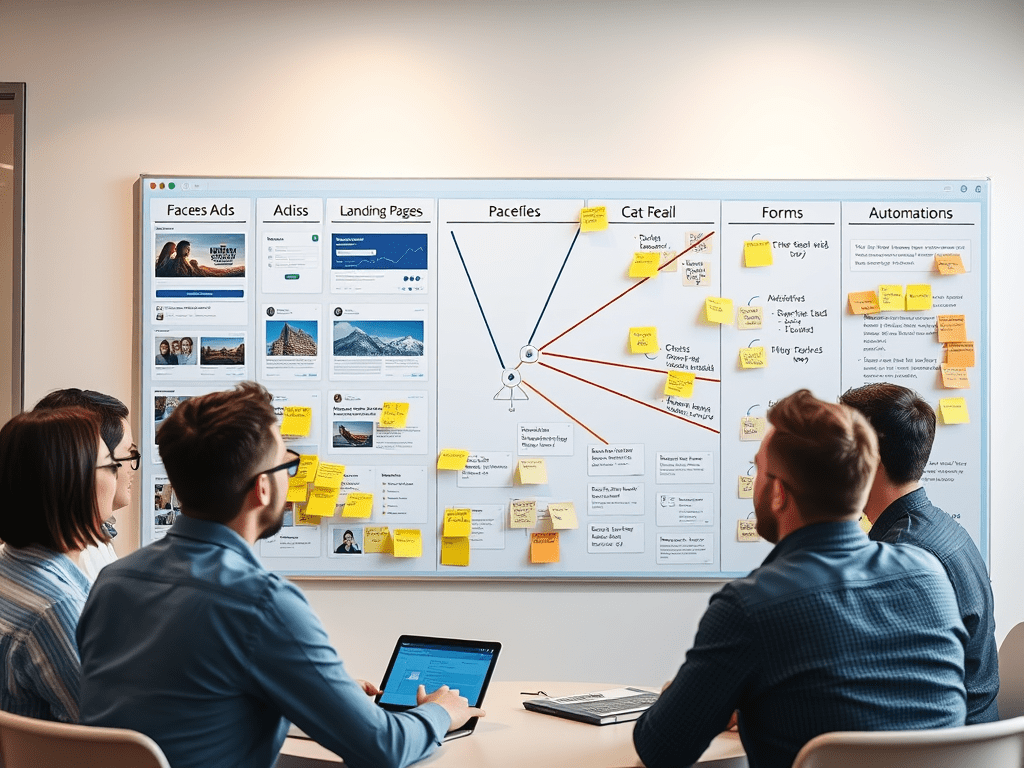
The First 30 Days: Funnel Immersion and Creative Deconstruction
Facebook/Meta Ads are not just media buying—they are funnel deployment systems. If you don’t understand what happens after the click, you won’t be able to optimize what happens before it.
In the first 30 days, I immerse every new hire in the complete journey:
- They map the funnel for a few key clients.
- They go through the ad, the landing page, the form, the email follow-up, the retargeting, and even the CRM data if available.
I want them to see how everything connects. Because one weak link—say, a confusing CTA or a broken post-submit email—can ruin a perfectly optimized campaign. And if a media buyer doesn’t understand the full system, they’ll be stuck chasing ghosts in Ads Manager.
We also do deep dives into creative. I pull up old ads—some winners, some total flops. We break them down in group sessions:
- What was the hook?
- Who was the ad talking to?
- What pain point did it surface?
- What did the comments say?
I’ve had new team members shocked when they see a polished brand video underperform a raw iPhone testimonial. That’s a lesson you can’t teach on a slide deck—it has to be experienced.
I want them to understand that Facebook ad success lives and dies in the scroll. If your ad doesn’t stop the thumb and emotionally engage, you’ve already lost.

Structuring Campaigns for Control, Learning, and Scale
Campaign structure in Meta Ads can feel like a moving target—every six months, something changes. But the principles stay the same. Structure isn’t just about neatness; it’s about giving yourself control and clarity so you can scale.
I train my team to build campaigns with three things in mind:
- Control: Can you isolate variables to learn what’s working?
- Clarity: Can someone else on the team jump into your account and understand it in five minutes?
- Scalability: Can this setup grow with the budget, audience size, or product offering?
We talk about:
- When to use ABO vs. CBO
- The difference between testing audiences and testing creative
- How to bucket campaigns by funnel stage (TOFU, MOFU, BOFU)
- The use of naming conventions like:
TOFU_CreativeTest_Video1_AudioCTA
I once had a junior specialist trying to fix a campaign that had ten ad sets, each with overlapping audiences, and random naming conventions like “Test 1.” We spent a day rebuilding it from scratch—grouping by funnel stage, using naming that matched the funnel, and limiting overlap with exclusions. Two weeks later, ROAS doubled.
Structure is strategy. I hammer that home.

Creative Strategy Is the Core of Meta Ads
When Facebook works, it’s because the ad spoke to someone. Period. You can mess up a lot of things and still get results if your creative hits. But if your creative doesn’t land, nothing else will save you.
That’s why I say: creative is the media plan.
Every week, we do live creative reviews. I make my team:
- Watch the first 3 seconds of every video and explain what they felt
- Score image ads on visual clarity and emotional pull
- Highlight comments that indicate resonance (or backlash)
I teach storytelling like a copy chief. We study:
- Hook frameworks like PAS and Before-After-Bridge
- User-generated content (UGC) formatting
- Customer testimonial scripting
- Emotional contrast in visuals (pain → solution)
We build out swipe files, make predictions before testing, and write notes afterward on what actually worked. I want my team to become creative strategists, not just button pushers.
Great media buyers don’t just run ads—they guide stories through the funnel.

Optimization Without Obsession
One of the worst habits I had to break in myself—and later in my team—was compulsive optimization. Refreshing dashboards, tweaking bids daily, obsessing over CTR.
Now, I train optimization like a scientist:
- What’s our hypothesis? (e.g. “This testimonial will outperform the founder-led video because it builds more trust.”)
- What are we isolating? (One variable at a time.)
- What outcome are we targeting? (CPL, ROAS, scroll stop rate, etc.)
We keep a shared doc called the “Testing Tracker.” Every test gets logged with:
- Campaign and asset name
- Hypothesis
- Results
- Learnings
We also run what I call the Drop-Off Dive every Friday:
- Ad → LP clickthrough rate
- LP → form submit rate
- Form → booked call rate (or sale)
This full-funnel view prevents the classic mistake of over-optimizing top-of-funnel metrics while ignoring the real conversion engine.
Retargeting That Respects the Customer
I’ve seen too many retargeting campaigns that feel like spam—ads shouting “Hey! You forgot something!” like a desperate ex.
Instead, I train my team to treat retargeting like a second chance to build trust. We explore:
- Objection handling: What might have made them hesitate?
- Value building: What can we offer that’s new—case study, guarantee, social proof?
- Tone shifts: Move from salesy to supportive (“Still thinking about it?” vs. “Buy now or miss out!”)
We build layered retargeting:
- Viewed video → case study
- Added to cart → product demo
- Visited pricing page → testimonial + guarantee
This turns retargeting into nurture, not noise.

Reporting That Tells a Story
I tell my team: If your report doesn’t answer “So what?”, it’s not done.
We teach reporting as strategy presentation, not data dumping.
Each report includes:
- Top 5 creative assets by performance, with commentary
- Funnel stage metrics (TOFU/MOFU/BOFU) with analysis
- Budget allocation, performance summary, and what’s next
I make them record Looms walking through their thinking. The goal isn’t to impress with big numbers. The goal is to show the client we understand their business and are moving it forward.

What Growth Looks Like
I know someone’s growing when they:
- Ask for customer call recordings
- Recommend landing page improvements without being asked
- Build offer frameworks, not just ads
They’re not just executing—they’re strategizing.
We have monthly growth reviews where we look not at metrics, but mindset. What did you learn? What risk did you take? Where did you lead?
That’s where real growth lives.

Final Words
I didn’t learn Facebook Ads from a course. I learned them from launching campaigns at 2 AM for panicked founders. From answering for lost spend. From rebuilding broken funnels in the middle of client calls.
Now I train people with that same energy: no fluff, just real talk, deep context, and accountability.
We don’t chase hacks. We build marketers.
If you’re building your team—or building yourself—I hope this gives you a real place to start.


 Marketing Unplugged
Leave a Reply