

(The Marketing Ecosystem — Part 1: Growth Strategy)
You can have the best ad creative, the strongest offer, and a steady stream of traffic — and still fail to convert.
That’s because the real battle isn’t for attention.
It’s for momentum — what happens in the few seconds after someone clicks.
Funnel optimization is about managing that momentum. It’s the process of removing friction, adding clarity, and guiding people naturally from interest to action.
If you’ve ever wondered why people click but don’t buy, this is where you find your answers.
The Truth: Every Funnel Leaks
Every funnel — no matter how polished — leaks somewhere.
The question isn’t if, it’s where.
Leads slip away in micro-moments:
- A confusing form field.
- A headline that doesn’t match the ad.
- Slow page load.
- Missing proof.
- Too many steps, not enough trust.
Most businesses try to fix funnels by “redesigning” them.
But optimization isn’t decoration — it’s diagnosis.
Step 1: Start With a Funnel Map
You can’t fix what you can’t see.
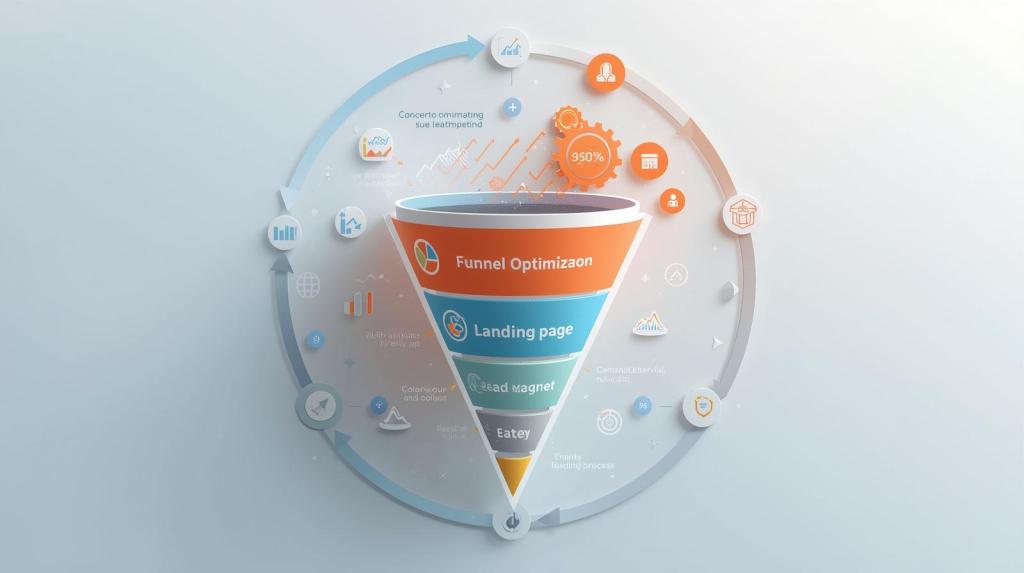
Start by mapping the full journey from first impression to final conversion.
That includes:
- Ad click or entry point
- Landing page
- Lead magnet or form
- Follow-up sequence
- Sales or booking process
Label every step. Note the conversion rate between each.
Your lowest-performing transition is your first leverage point.
Most of the time, fixing one weak link outperforms rebuilding the entire chain.
Step 2: Match Message to Moment
Message mismatch is the #1 funnel killer.
If your ad promises one thing and your landing page opens with another, trust breaks instantly.
Here’s the test:
- If someone clicks your ad headline and lands on your page, does it feel like a continuation or a new story?
- Do your visuals and tone feel consistent across the journey?
People don’t convert when they feel confused — they convert when they feel understood.
Step 3: Optimize for Clarity, Not Cleverness
Clever copy wins awards.
Clear copy wins conversions.
Your funnel should answer three questions within five seconds:
- What is this?
- Who is it for?
- What do I do next?
If any of those are unclear, your bounce rate will climb — no matter how good your design looks.
A few simple clarity rules:
- Use plain, human language.
- Keep primary CTAs visible without scrolling.
- Reduce the number of competing actions per page.
Confusion kills conversions. Simplicity scales them.
Step 4: Build Proof Into Every Stage
People want to believe you — but they need reasons to.
Social proof, testimonials, and real data aren’t optional.
They’re the bridge between skepticism and action.
Each funnel stage needs proof that fits its moment:
- Top of funnel: authority and credibility (press, stats, credentials).
- Middle of funnel: relevance (testimonials, reviews, transformation stories).
- Bottom of funnel: reassurance (guarantees, refund policies, safety signals).
Never assume “they already know.”
Assume they’re questioning everything — and answer before they ask.
Step 5: Reduce Friction Everywhere
Every extra step, field, or delay costs conversions.
Ask:
- Can I remove one click?
- Can I shorten one sentence?
- Can I make one decision easier?
Optimization is often subtraction.
Remove everything that doesn’t move people closer to “yes.”
Sometimes that means fewer choices, sometimes it means faster feedback.
Example:
One healthcare client reduced their intake form from 12 fields to 5 — keeping only the essentials.
Conversion rate jumped 62% overnight.
They didn’t add anything. They just stopped making people work so hard.
Step 6: Build Trust Into the Microcopy
Microcopy — the small words on buttons, labels, and confirmations — quietly drives big results.
Instead of “Submit,” try “Book My Free Consultation.”
Instead of “Continue,” try “Show Me My Plan.”
Small shifts like that reassure people about what happens next.
Good microcopy feels conversational. It makes the journey feel guided, not transactional.
Step 7: Make Speed and UX Invisible
People don’t notice fast pages — but they do notice slow ones.
Speed, mobile optimization, and accessibility aren’t technical details; they’re conversion levers.
Use tools like Google Lighthouse, GTmetrix, or Hotjar to track load time and scroll behavior.
If users drop off before seeing your CTA, it’s not their attention span — it’s your layout.
The smoothest funnels feel invisible — nothing distracts from the decision.
Step 8: Test Relentlessly, but Strategically
A/B testing is essential — but not everything needs to be tested at once.
Prioritize based on impact and ease.
- Headlines and CTAs → high impact, low effort.
- Offer framing or pricing → medium effort, high impact.
- Entire page redesign → high effort, uncertain gain.
Each test should have one clear hypothesis.
“Changing X will increase Y because Z.”
Optimization without a reason is just guessing with better tools.
Step 9: Follow Up Like a Human
Funnel optimization doesn’t end at the form submission.
Your follow-up process — emails, calls, texts — determines whether a lead converts or disappears.
Most funnels drop the ball here.
If you wait 24 hours to follow up, half your leads are gone.
If your first email is a template, most will ignore it.
Personalized, timely communication is the easiest win in optimization.
Even a short, real message beats automation fatigue.
Real Example: The $40k Fix
A client in the B2B SaaS space came to me frustrated — thousands in ad spend, but low demos booked.
We mapped their funnel. The issue wasn’t traffic or targeting — it was trust.
The landing page headline didn’t match the ad. The form felt intrusive. No testimonials.
We rewrote the copy to mirror the ad promise, shortened the form, and added two short client quotes near the CTA.
Demo signups increased 41% within two weeks.
That small fix was worth $40,000 in new pipeline the next quarter.
That’s what funnel optimization really does — it turns missed moments into measurable results.
Step 10: Keep a “Funnel Journal”
Document everything you test, fix, and learn.
Every insight compounds.
A “Funnel Journal” helps you avoid repeating mistakes and accelerates optimization over time.
Include:
- What was changed
- The reason behind it
- The measured result
- What you’ll test next
Within a few months, you’ll have your own playbook for how your audience actually behaves — not how you assume they do.
That’s data money can’t buy.
The Takeaway: Funnels Don’t Fail — They Just Stop Evolving
Every funnel has a life cycle. What worked six months ago might underperform today.
The key isn’t to chase new tools — it’s to build a mindset of constant improvement.
Optimization isn’t a campaign.
It’s a discipline.
And when you treat it that way, your funnel stops being a bottleneck and becomes your biggest advantage.
Next in the Series
Next up: “CAC vs. LTV: The Numbers That Decide If You’re Growing or Just Spending.”
We’ll dig into how to balance acquisition cost and lifetime value — and why sustainable scaling depends on getting those numbers right.
CTA
If your funnel feels like it’s leaking leads, the Palalon Growth Audit Roadmap identifies where momentum is breaking — and helps you fix it fast.

 Marketing Unplugged
Leave a Reply