

(The Marketing Ecosystem — Part 2: Branding & Identity)
Most people think trust is built through great products or promises kept.
That’s true — but it’s only half the story.
The other half is consistency — showing up the same way, every time, across every touchpoint.
Because if a brand looks, sounds, or feels different every time someone encounters it, it creates a silent kind of doubt:
“Which version is real?”
Consistency removes that doubt.
And when people know what to expect from you, they relax into trust.
The Psychology Behind Consistency
Our brains are wired for recognition.
Familiar patterns save energy — they make us feel safe.
That’s why you can spot a Starbucks cup from across an airport or know a Nike ad before the logo appears.
The visuals, tone, and rhythm feel familiar. Predictable. Reliable.
Consistency is trust translated into design and language.
It says: “We mean what we say, and we’re still the same brand you trusted last time.”
When you master that, your marketing starts compounding instead of restarting with every campaign.
Step 1: Define What “Consistency” Actually Means
Consistency isn’t uniformity — it’s coherence.
It doesn’t mean every post, ad, or email looks identical.
It means every piece feels like it belongs to the same family.
A consistent brand:
- Uses the same core color palette and typography hierarchy.
- Speaks in a recognizable tone, even across contexts.
- Repeats its key ideas and values, not just its visuals.
- Reflects the same attitude whether in an ad or an apology.
In short: consistency builds identity.
It turns one-time impressions into lasting associations.
Step 2: Build a Single Source of Truth
Inconsistent brands almost always share one problem: scattered brand assets.
Designers save versions on desktops.
Marketers tweak colors in Canva.
Sales reps make their own decks.
Suddenly, there are five logos floating around the company and no one knows which is official.
The fix is simple — but powerful.
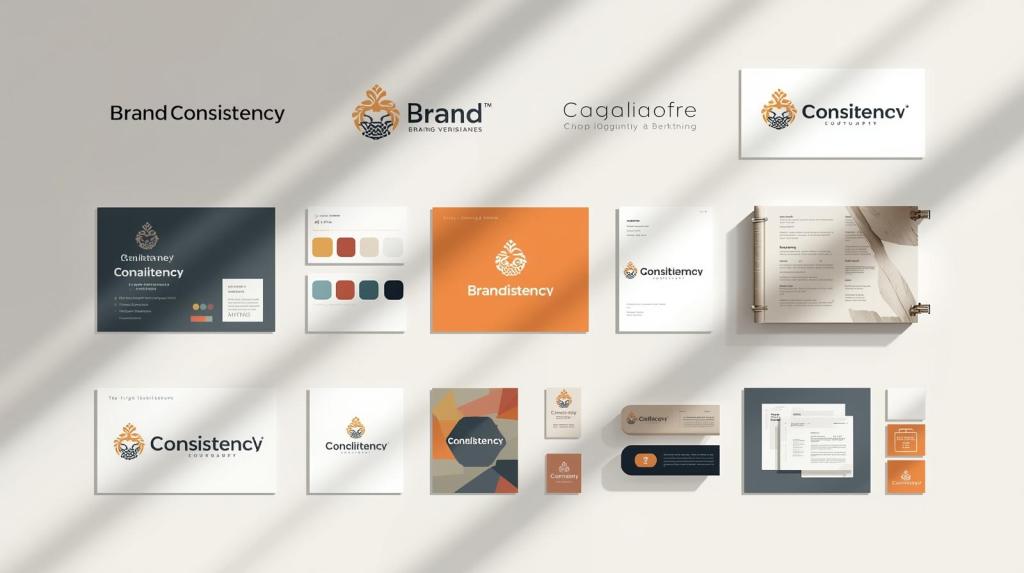
Create one brand hub where everyone can access the latest assets, templates, and messaging.
That hub should include:
- Logos and variations (in all formats)
- Color codes and usage rules
- Fonts and text styles
- Photography and illustration libraries
- Messaging and tone guidelines
- Example posts, slides, and layouts
When your team has a single source of truth, you stop losing brand control one “quick edit” at a time.
Step 3: Align Internal and External Consistency
A consistent brand doesn’t start in marketing — it starts in culture.
If your internal communication doesn’t match your external image, your audience will feel it.
For example:
If your brand voice online is “friendly and transparent” but your internal emails are cold and formal, that inconsistency leaks into your customer experience.
Your employees are your brand ambassadors.
If they don’t live the same tone and values they’re selling, consistency collapses from the inside out.
Make sure your team understands not just what your brand looks like, but what it feels like.
Step 4: Audit Every Touchpoint
It’s easy to keep your website and ads aligned — but brand drift hides in the details.
Audit every place your brand lives:
- Social media bios and headers
- Automated email signatures and templates
- Sales decks and proposal PDFs
- Customer support messages
- Recruiting materials and job listings
Each of these should reflect the same design, tone, and message principles.
If they don’t, you’re sending mixed signals without realizing it.
The goal is that a prospect, customer, or job applicant should have the same brand experience no matter where they meet you.
Step 5: Document the Intangibles
You can’t automate tone, energy, or emotion — but you can document how they should feel.
Add a Brand Personality Section to your brand guide that includes:
- Core emotions: what people should feel after interacting with your brand (e.g., “clarity,” “confidence,” “relief”).
- Behavioral traits: how your brand behaves (e.g., “We explain, not preach. We simplify, not oversimplify.”).
- Visual rhythm: how layouts, photography, and motion reinforce your tone.
This bridges design with intent — helping everyone translate emotion into execution.
Step 6: Measure Consistency Over Time
Consistency isn’t just a creative metric — it’s measurable.
You can track it through:
- Brand recall surveys: Do people recognize your brand without seeing the logo?
- Engagement analysis: Do consistent visuals perform better? (They usually do.)
- Message alignment: Do employees describe your brand similarly in their own words?
If your audience and your team can both describe your brand the same way — you’ve hit the sweet spot.
Step 7: Automate Consistency Where Possible
Tools can’t replace brand discipline, but they can support it.
Use:
- Shared Canva / Figma libraries for design templates.
- Pre-approved copy banks for ads, emails, and social posts.
- CRM-integrated brand elements (logos, colors, templates).
- Centralized feedback systems so changes don’t get lost in private chats.
Automation keeps your system honest — it reduces drift caused by speed or forgetfulness.
Step 8: Teach the “Why,” Not Just the “What”
When people understand why consistency matters, they naturally protect it.
So instead of just enforcing rules (“Use this font, not that one”), teach the reason:
“We use this color because it reinforces calm.”
“We write in this tone because it builds trust.”
The more your team understands purpose, the less they’ll need policing.
That’s how consistency becomes culture — not compliance.
Step 9: Refresh Without Losing Recognition
Over time, your visuals and voice will evolve. That’s healthy.
But when you update your brand, evolution should never break familiarity.
Think of it like updating a home: you can modernize the furniture and lighting — but the foundation and floor plan stay the same.
Retain recognizable elements: color anchors, typography families, key phrasing.
Add freshness subtly, not abruptly.
The goal isn’t to reinvent recognition — it’s to keep it alive.
Real Example: The Telehealth Brand That Reinforced Consistency
A telehealth client of mine had a good product but fragmented branding.
Different clinics used different logo variations, colors, and ad messaging.
We centralized everything — one visual system, one tone guide, one shared content hub.
We also built a 30-minute “brand rhythm” training for all clinic managers.
Within three months, their social engagement rose 40%, new patient inquiries increased, and reviews began mentioning professionalism and “cohesive experience.”
Nothing else changed — just consistency.
That’s the compounding effect of alignment: every piece of marketing starts reinforcing the next.
The Takeaway: Familiarity Builds Credibility
Your audience can’t always explain why they trust you — they just feel it.
That feeling comes from repetition, rhythm, and reliability.
Every consistent message deepens the impression that you’re stable, dependable, and worth remembering.
Because in a noisy market, the brands that win aren’t always the loudest.
They’re the ones people can identify instantly — and believe in completely.
Consistency isn’t boring. It’s powerful.
It’s how your brand turns recognition into relationship.
Next in the Series
Next up: “Rebranding & Brand Refresh: Knowing When and How to Evolve Without Losing Yourself.”
We’ll unpack how to handle a rebrand gracefully — without confusing your audience or abandoning the equity you’ve built.
CTA:
If your brand feels inconsistent across platforms or teams, it’s not a creative issue — it’s a system issue.
The Palalon Growth Audit Roadmap includes a Brand Consistency Audit that identifies gaps across your channels, documents your standards, and builds a system your team can actually maintain.

 Marketing Unplugged
Leave a Reply