

(The Marketing Ecosystem — Part 1: Growth Strategy)
You can have great branding, steady leads, and busy sales calls — and still not be growing.
Why?
Because revenue isn’t the same as return.
That’s where two critical metrics come in: CAC and LTV.
They’re the numbers that tell you whether your marketing is actually working — or just making noise.
What They Mean (Without the Jargon)
Let’s start simple.
- CAC (Customer Acquisition Cost) = how much it costs you to get one new paying customer.
Think: ad spend, salaries, software, and sales effort — everything it takes to acquire a customer. - LTV (Lifetime Value) = how much revenue that customer brings you over their entire relationship with your brand.
In short, CAC tells you what it costs to win business.
LTV tells you what that business is worth once you win it.
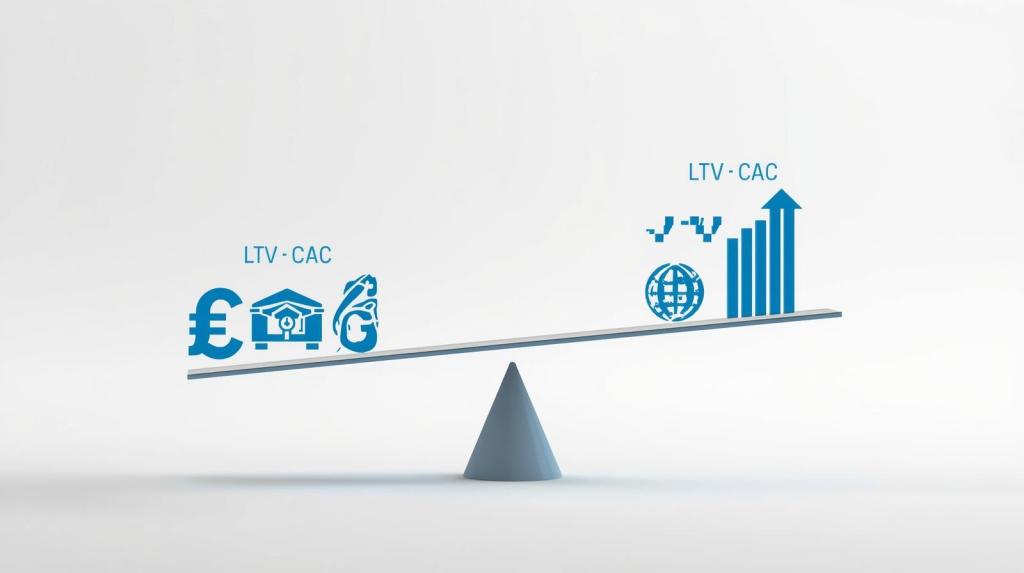
The balance between the two decides whether your company scales or stalls.
The Golden Ratio: LTV Should Be 3x CAC
As a rule of thumb, healthy businesses aim for an LTV:CAC ratio of 3:1.
That means for every dollar you spend to acquire a customer, you should make at least three dollars back over time.
- 1:1 means you’re breaking even — you’re buying revenue, not earning it.
- 2:1 means you’re profitable, but not scalable.
- 3:1 or better means you can confidently reinvest and grow.
This ratio is the difference between marketing as an expense and marketing as an asset.
Why Most Brands Don’t Know Their Real CAC or LTV
Here’s the problem: most companies think they know these numbers — but their math is wrong.
They look at surface-level data, like “cost per lead” or “cost per sale,” without factoring in hidden layers:
- Retargeting and brand spend.
- Team time and tech stack costs.
- Discounts, churn, or refunds.
Same goes for LTV — it’s not just your average order value. It’s that value multiplied by repeat purchases, retention duration, and expansion revenue.
If you’re not factoring in time, your numbers are lying.
Real CAC and LTV are about behavior, not spreadsheets.
Step 1: Calculate CAC Correctly
Add up everything it takes to bring in a customer:
- Paid media spend (Google, Meta, LinkedIn, etc.)
- Sales and marketing team salaries (proportionally)
- Software and automation tools
- Creative and content costs
- Agency fees (if applicable)
Then divide that total by the number of new paying customers you acquired in that period.
Example:
You spent $60,000 last month on marketing and sales combined, and brought in 120 customers.
Your CAC = $500.
That’s your true cost per customer — not just ad spend.
Step 2: Calculate LTV Accurately
LTV depends on three things:
- Average Purchase Value — how much people spend per transaction.
- Purchase Frequency — how often they buy.
- Customer Lifespan — how long they stay.
Formula:
LTV = Average Purchase Value × Purchase Frequency × Customer Lifespan
Example:
If your average customer spends $250 per month and stays for 10 months, your LTV = $2,500.
Now you can see the balance clearly:
If CAC is $500 and LTV is $2,500 → 5:1 ratio. That’s healthy.
If CAC is $1,000 and LTV is $1,500 → 1.5:1. You’re in trouble.
Step 3: Use the Ratio to Drive Decisions
Your CAC:LTV ratio should inform every major growth decision:
- Ad Spend: Are you scaling profitably or just increasing cost?
- Pricing: Does your pricing model sustain acquisition cost over time?
- Retention: Are you keeping customers long enough to justify what you paid to get them?
If your ratio is off, don’t cut spend first — fix the leaks.
Lowering CAC or increasing LTV both solve the same equation, but in different ways.
How to Lower CAC (Without Killing Quality)
- Tighten Targeting: Stop marketing to “everyone.” Precision saves money.
- Improve Creative: Clarity outperforms creativity when it comes to performance.
- Boost Conversion Rate: Even small improvements compound across your funnel.
- Add Referrals: Customers acquired via referrals often have 30–50% lower CAC.
- Align Sales and Marketing: Disconnect between them is one of the biggest cost drivers.
Lowering CAC is about efficiency — not cheapness.
How to Increase LTV (Without Heavy Discounts)
- Improve Onboarding: The first 7 days decide how long people stay.
- Add Upsells or Cross-Sells: Grow value per customer before chasing new ones.
- Build Retention Loops: Automate re-engagement and reminders.
- Focus on Experience: The better the experience, the higher the return rate.
- Turn Customers Into Advocates: Word-of-mouth is free lifetime marketing.
Higher LTV means you can afford higher CAC — and still grow.
That’s when marketing stops feeling like cost and starts feeling like compound interest.
Example: The Subscription Business That Almost Drowned
A wellness subscription brand came to me in panic.
They were spending $200k/month on ads and bragging about customer volume — but profit was thin.
Their CAC was $190, and their average customer stayed only 2 months at $99/mo.
That’s $198 LTV — almost break-even.
The fix wasn’t to cut ad spend — it was to extend retention.
We:
- Redesigned onboarding emails to teach customers how to use the product effectively.
- Added milestone rewards for month 3 and 6.
- Launched a loyalty program tied to referrals.
Within 90 days, retention jumped to 6 months.
LTV rose to $594 — CAC stayed the same.
Their ratio flipped from 1:1 to 3:1.
That’s what sustainable scaling looks like.
Step 4: Forecast, Don’t Guess
Once your CAC and LTV are solid, you can start modeling growth like a real operator — not a guesser.
For example:
If your CAC is $400 and LTV is $1,600, you know that for every $100k in ad spend, you’ll generate roughly $400k in lifetime revenue.
Now you can plan scaling budgets, predict payback periods, and forecast confidently.
That’s when marketing turns into a predictable growth engine — not a gamble.
Step 5: Revisit Quarterly — Markets Change Fast
Your CAC and LTV are never static.
Algorithm shifts, pricing changes, and buyer behavior all evolve.
Recalculate these every quarter to make sure your growth model is still reality-based.
Sustainable companies don’t wait for CFOs to tell them what’s wrong.
They monitor these ratios like pulse and blood pressure.
The Takeaway: Profitability Lives Between These Two Numbers
CAC and LTV are more than metrics — they’re your business heartbeat.
If CAC rises faster than LTV, you’re in trouble.
If LTV grows faster than CAC, you’re scaling safely.
Keep your ratio healthy and your growth intentional.
That’s how companies evolve from “busy” to profitable.
Because in the end, it’s not about how much you make — it’s about how much stays.
Next in the Series
Next up: “Product-Led Growth: When the Product Itself Becomes the Marketing.”
We’ll explore how to turn your product experience into your strongest acquisition and retention channel — even if you’re not SaaS.
CTA
If you’re spending heavily but not sure if it’s paying off, the Palalon Growth Audit Roadmap helps uncover your true CAC, LTV, and scaling potential — before you waste another dollar.

 Marketing Unplugged
Leave a Reply