
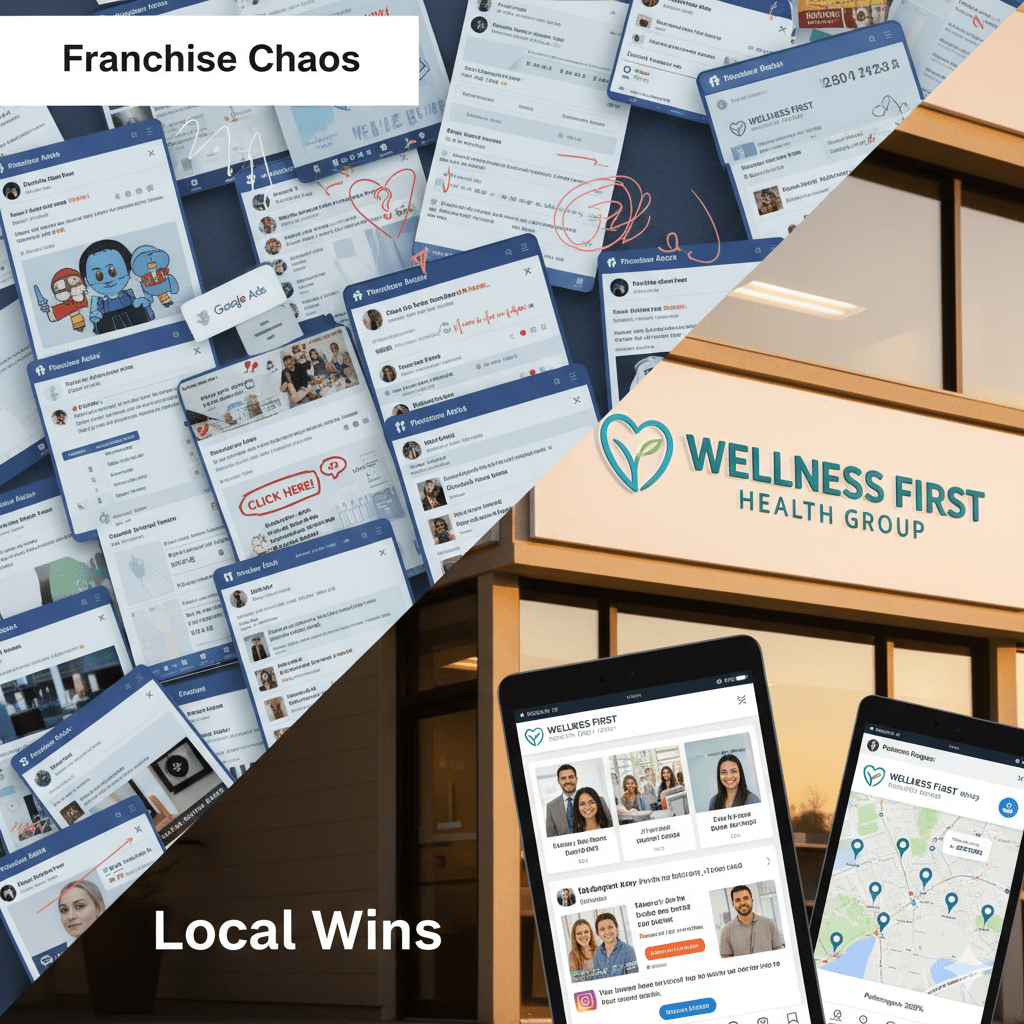

Franchise growth is supposed to mean scale. More locations, more reach, more customers. But for many operators, growth feels less like opportunity and more like chaos.
That was the situation one multi-location healthcare group faced when they brought me in. They had more than 30 urgent care and specialty clinics spread across different cities. Each location was trying to “do marketing” in its own way.
Some ran their own Google Ads campaigns with no tracking. Others boosted random Facebook posts from personal pages. A few ignored marketing completely, relying on outdated signage and word of mouth. The corporate team tried to impose brand standards, but franchisees pushed back, frustrated by rules that didn’t bring them leads.
The result? A brand that looked polished on paper but scattered in reality. Some clinics were invisible online. Others wasted thousands of dollars every month on untracked ads. Customers saw inconsistent messaging, inconsistent reviews, and inconsistent experiences.
The CEO’s words stuck with me: “We’re not one company anymore. We’re 30 separate experiments, and most of them are failing.”
This is the story of how we turned that chaos into a system. How we built a playbook that respected local needs but enforced brand consistency. And how, within months, patients stopped slipping through the cracks and every location finally started winning.
The Problem: Brand Without Local Power
On paper, the group looked strong. A recognizable brand name, standardized signage, and clinics spread across multiple markets. But when we pulled back the curtain, the marketing reality was fractured.
- No unified digital presence. Some locations had Google Business Profiles claimed, others didn’t. Reviews varied wildly — a few with glowing feedback, many with angry one-stars left unanswered.
- Ad spend in silos. Individual managers were running their own Google Ads accounts, often without tracking or attribution. One location was paying $40+ per click just to show up for its own brand name.
- Inconsistent creative. Facebook ads ranged from corporate-looking graphics to blurry photos with typos. There was no cohesive message, no alignment with the main brand identity.
- Customer confusion. A patient in one city would see polished messaging and quick booking. In another, they’d hit an outdated page that barely loaded on mobile. The brand promise wasn’t consistent, and trust was eroding.
- Wasted dollars. Collectively, the group was spending tens of thousands of dollars every month — but with no centralized reporting, no one could say what was working or what was wasted.
The leadership team was stuck between two extremes:
- Force rigid corporate control and risk alienating franchisees.
- Allow everyone to “do their own thing” and watch the brand dilute into 30 different versions of itself.
Neither option was working.
This wasn’t just inefficient. It was dangerous. Competitors with tighter systems were appearing higher in search results, dominating local map packs, and presenting a unified, trustworthy face to patients across multiple markets.
Meanwhile, this group was fighting itself.
Diagnosis: Where Multi-Location Marketing Falls Apart
The first step was mapping the system as it really existed — not what corporate leadership thought was happening, but what was actually happening at the ground level.
Here’s what we uncovered:
- No Centralized Playbook
Each location was improvising. Some managers leaned on old templates, others winged it completely. Without a common framework, the brand fractured into dozens of different voices. - Local SEO Ignored
Many Google Business Profiles were unclaimed or half-complete. Business hours were outdated. Photos looked like they were taken on flip phones. For a business that relies on “near me” searches, this was a silent killer. 🔗 Local SEO Beyond the Basics: Advanced Citation & Reputation Strategies - Tracking and Attribution Were Nonexistent
Nobody knew where leads were coming from. Was it Google Ads? Facebook? Organic search? A walk-in? Without clarity, good campaigns weren’t being scaled and bad ones weren’t being cut. - Uncoordinated Reviews
Some locations actively asked for reviews. Others ignored them. The result: a brand with hundreds of reviews at one clinic and a blank profile at the next. Patients noticed. Google noticed too. - Reporting Was Fragmented
Corporate saw only big-picture spend, not individual performance. Local managers had no visibility into whether their dollars were wasted or working.
This diagnosis explained why the CEO described it as “thirty different experiments.” That’s exactly what it was — a franchise system without a unifying backbone.
The challenge wasn’t about picking the right ad channel or creative. It was about building a system — one that respected local needs but pulled everyone under the same tent.
The Fix: Bringing Order to Chaos
We didn’t rip control away from franchisees, and we didn’t drown them in rules from corporate. Instead, we built a system that gave them tools to succeed while keeping the brand consistent.
1. A Centralized Playbook
We created a marketing playbook that every location could plug into. It wasn’t theory — it was practical:
- Ad templates that could be localized with the clinic’s city or neighborhood name.
- Landing page frameworks that carried the same design and messaging but let locations add their own photos and staff bios.
- Clear rules on what campaigns corporate would fund versus what franchisees could run locally.
This playbook gave local managers freedom within guardrails — consistency without stifling.
2. Local SEO Standardization
We audited and rebuilt every Google Business Profile. Hours, addresses, photos, and services were updated. We added location-specific keywords, uploaded staff images, and built a review request system that every clinic followed.
Within 90 days, the group’s clinics went from scattered search visibility to dominating local map packs.
🔗 Storytelling in the Age of Shifting SEO (2025–2026)
3. Unified Tracking & Dashboards
Every campaign was plugged into a centralized dashboard. Corporate could finally see where leads were coming from. Local managers could finally see which dollars were driving results.
That transparency cut waste fast. Ads that never produced leads were turned off. The budget flowed toward what worked.
4. Call Tracking & Lead Routing
We installed call tracking numbers for every location, tied back to campaigns. Missed calls went to a live answering service instead of voicemail. Intake scripts were standardized, so the customer experience was the same in City A as it was in City B.
5. Reputation Engine
We added an automated review request workflow. Every patient got a text follow-up with a simple question: “How was your visit today?”
Happy patients were nudged to leave a Google review. Unhappy ones were flagged for a manager to call personally. The result was a steady climb in positive reviews and a drop in public complaints.
By the end of the rollout, every location was playing from the same sheet of music. Local managers stopped guessing. Corporate stopped firefighting. Patients got a consistent, trustworthy experience no matter which clinic they walked into.
The Results: From Chaos to Consistency
Six months after rolling out the playbook, the difference was night and day.
- Consistent Visibility: Every location showed up in the local map pack for its city. Search results were no longer hit-or-miss — they were predictable.
- Lower Cost per Lead: With wasted campaigns shut down and ads standardized, cost per lead dropped by 28% across the system.
- Reviews Skyrocketed: Collectively, reviews across the group grew by 300% in three months. Negative feedback was caught early and handled privately.
- Call Capture Improved: Missed calls went down by more than half. Patients were actually speaking with intake staff instead of hitting voicemail.
- Franchisee Buy-In: Local managers stopped resenting corporate because they finally saw results from standardized systems. Instead of chaos, they had a framework they could trust.
One regional director put it bluntly:
“Before this, marketing felt like a fight — corporate versus local, with patients caught in the middle. Now it feels like we’re all rowing the same direction. Patients don’t see 30 different clinics anymore. They see one consistent, reliable brand.”
The numbers mattered, but what mattered more was perception. Patients felt they could trust the brand no matter which door they walked through. That’s what turned marketing chaos into patient confidence.
Lessons Any Franchise Can Steal
This group’s turnaround wasn’t about magic or luck. It was about putting systems in place that every multi-location brand needs.
1. Local SEO and Reviews Are Non-Negotiable
Franchises often obsess over national campaigns but neglect the basics. If your local listings are inconsistent, customers won’t find you.
Example: A gym franchise I reviewed had locations with unclaimed Google profiles. Once we standardized hours, uploaded photos, and launched a review engine, walk-ins increased 20% — without a single new ad.
🔗 Local SEO Beyond the Basics: Advanced Citation & Reputation Strategies
2. Centralized Systems Don’t Kill Local Creativity — They Enable It
Franchisees often resist corporate control, thinking it takes away freedom. But the reality is the opposite: when they don’t have to reinvent the wheel, they can focus on running their business.
Example: A med spa chain saw its franchisees stop wasting time building ad creatives from scratch. Corporate gave them tested templates. Franchisees just swapped in local photos and offers — saving hours and improving results.
3. Without Data, Dollars Are Wasted
Guessing kills growth. If you don’t know what’s working, you’ll keep paying for what isn’t.
Example: A quick-service restaurant group spent thousands on local Facebook ads with no tracking. After adding centralized dashboards and call tracking, they realized half their spend wasn’t generating a single order. Those dollars were reallocated to campaigns that doubled delivery orders.
4. Balance Brand Consistency With Local Authenticity
Customers want the reliability of a known brand — but they also want to feel a connection to their neighborhood. The trick is to give local managers tools that showcase both.
Example: For the healthcare group, we used standardized landing pages but let each clinic feature staff bios and real patient photos. The brand stayed consistent, but each location felt personal.
The bottom line: whether you’re running a healthcare group, a chain of gyms, a med spa franchise, or a restaurant network, the challenge is the same. Growth comes from systems that make local marketing consistent, measurable, and trustworthy.
Why This Matters Now
Franchise and multi-location brands are under more pressure than ever.
- Local search dominates. Google continues to push “near me” and map-pack results above everything else. If your local listings aren’t optimized and consistent, you’re invisible.
- Competition is ruthless. Urgent care chains, gyms, med spas, restaurants — every category has new players entering the market, all fighting for the same customer attention.
- Ad costs are rising. Paying for clicks is expensive. If your funnel is fractured, you’re paying premium prices for leads that never convert.
- Customer expectations are higher. People don’t tolerate clunky booking flows or unanswered calls anymore. They go to the competitor that makes it easy.
That’s why systems matter now more than ever. A franchise without a unified marketing backbone will lose ground — not because their product or service is worse, but because customers can’t find them, don’t trust them, or can’t book them quickly enough.
This is the reality of 2025 and 2026: the brands that thrive will be the ones that combine brand consistency with local authenticity. They’ll dominate local SEO, standardize intake and follow-up, and give customers the same seamless experience across every location.
The ones that don’t? They’ll keep fighting the same battles this group once did: wasted dollars, frustrated franchisees, and patients walking through a competitor’s door.
Call to Action
If your franchise or multi-location brand feels like thirty different experiments instead of one consistent system, you don’t have a visibility problem. You have a structure problem.
That’s exactly what we solve at Palalon Marketing Consulting.
We build marketing systems that bring order to chaos — unifying your brand while still giving local managers the tools they need to succeed. From local SEO to review engines, landing page frameworks to call tracking, we create the backbone that makes every location win.
You don’t need more ads. You need consistency, clarity, and a playbook that scales.
👉 Start here: Contact Palalon Marketing Consulting
We’ll audit your current setup, show you where the gaps are, and design a system that turns marketing chaos into measurable growth.

 Marketing Unplugged
Leave a Reply