
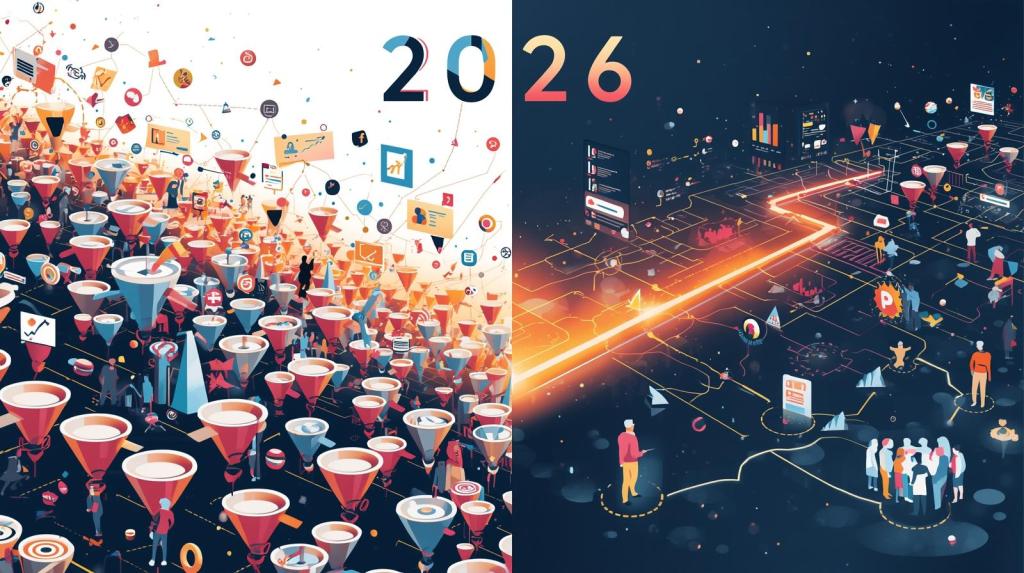

Let me put it straight: 2025 wasn’t an easy year for marketers. A lot of what we thought we could lean on started to crack. Funnels got bloated. Paid media costs kept rising while results flattened out. SEO got buried under AI spam. Social algorithms shifted every other month, and every time you thought you had them figured out, they changed again.
I’ve been in this game long enough to know these cycles. The industry builds up hype, then it crashes down to reality. And 2025 was one of those reality years. It forced all of us to stop, strip things back, and face what was actually working and what wasn’t.
But I don’t see that as a bad thing. In fact, I think 2025 was a reset we needed. The year that cut through the noise. It reminded us that fundamentals win. Funnels don’t need to be clever; they need to be clear. Ads don’t need hacks; they need good creative. SEO isn’t about volume; it’s about authority. Social isn’t about being the loudest; it’s about being real and belonging to a conversation.
So as we move into 2026, the smart question isn’t, “What’s the newest trick?” It’s, “What’s going to keep working as the rules shift again?” That’s what I want to unpack here. Funnels. SEM. SEO. Social. The whole lot.
Funnels: From Overbuilt to Straightforward
Here’s the truth: marketers love to overcomplicate funnels. And in 2025, that came back to bite us.
I can’t tell you how many clients I saw last year running funnel maps that looked like blueprints for a spaceship. Twelve steps. Multiple upsells. Three retargeting loops. Email drips that ran for months. It looked impressive in ClickFunnels or HubSpot. But in the real world? People dropped out halfway.
I’ll give you a real example. Early 2025, I was working with a healthcare provider who had copied a “proven” funnel from some guru course. The thing had ten steps. Forty-five days of nurture emails. Retargeting ads everywhere. The logic was so complex, even their marketing manager couldn’t explain it without pulling up a flowchart.
And guess what? Almost no one made it through. Leads went in, but they didn’t come out the other side.
We scrapped it. Rebuilt from scratch. One landing page. One form. One thank-you page. And a quick call booked. That’s it. Within three weeks, their conversion rate tripled. Tripled. Not because of some secret trick—because we removed the friction.
That’s the lesson of 2025: every extra click is a chance to lose someone. Every delay is a chance for them to wander. Every unnecessary form field is a reason to bail. People don’t want to be dragged through a maze. They want the fastest path to value.
What Worked
Speed and clarity. Funnels that respected attention and cut right to the point.
Post-click optimization was a quiet hero too. I saw clients add a simple 90-second explainer video on a thank-you page and watch their show-up rates double. Interactive calculators? Same story. People stuck around because the value was immediate.
And the best part? Funnels that leaned into zero-party data. Instead of tricking people into giving info, they made the exchange worth it. Like when I rolled out the ABA Growth Audit Roadmap. The form wasn’t “hand over your details.” It was, “Give us this info, and we’ll hand back a tailored roadmap.” People shared willingly because they saw the payoff.
What Didn’t Work
Bloated automations. Nobody read nurture email No. 14. Fake scarcity timers. Pop-ups screaming “only 3 left.” Retargeting that stalked people until they blocked you. Audiences in 2025 weren’t dumb. They knew when they were in a funnel. And if it felt manipulative, they bounced.
What’s Next in 2026
Here’s where we’re heading: shorter, trust-first funnels that feel like conversations. Each step has to earn its place. AI will help personalize experiences, but the key is making it feel like relevance, not surveillance.
If you want a deeper dive, check out my post-click optimization guide. Because in 2026, the funnel doesn’t end with the click. It starts there.
SEM & Paid Media: Creative Is the Lever, Not the Afterthought
Let’s talk paid media. 2025 was the year budgets alone stopped working.
I’ve managed ad spends north of $5M/month. I’ve seen what happens when the dollars are there but the creative is weak—you burn cash fast. And last year, that reality hit harder than ever. CPCs went up across the board. Platforms cut back on targeting options. Reporting got murkier. If you were running lazy campaigns—broad match, stale creative, over-automation—you watched your ROI tank.
The idea that “the algorithm will figure it out” was exposed as wishful thinking. Smart bidding is great, but it can’t rescue weak ads.
What Worked
High-intent search still delivered. If someone typed “urgent care near me” and your ad matched cleanly with a clear offer and fast landing page, you won. No trick—just relevance.
Meta Ads kept their power, but only when creative was fresh and tested relentlessly. I saw accounts that cycled through 20–30 ad variations every month while weaker competitors were still running the same ad from Q1. Guess who won?
And then there were the secondary platforms. Reddit, Quora, TikTok, even programmatic audio. Not replacements for Google or Meta, but strong side channels. I ran a Reddit test for an e-commerce supplement brand—cost per click was a fraction of Meta’s, and the leads were just as qualified. That extra channel gave breathing room when Meta costs spiked.
What Didn’t Work
Laziness. Broad match campaigns left unchecked. Creative slapped together because “we just need something to run.” Over-automation without guardrails—letting Google spend half the budget on irrelevant placements while nobody noticed until the client asked why the leads were junk.
And the big one: chasing vanity metrics. Engagement campaigns that got likes but no pipeline. Dashboards filled with clicks but no customers.
What’s Next in 2026
Paid media is entering the efficiency era. Budgets aren’t going down, but every dollar has to justify itself. Creative is the lever now. The platforms are evening out targeting. The difference-maker is whether your ad cuts through.
Expect more blending of organic and paid—ads that look like content people would’ve engaged with anyway. Native storytelling. Not interruptions.
And measurement? Forget impressions. 2026 will be about revenue-backed reporting. Show pipeline, not clicks.
If you want to see how this plays out, I broke down exactly how we cut CAC by 40% without cutting spend (full article here). That’s where this is going: discipline, testing, and creativity—not just money.
SEO & Content: Authority Over Algorithms
2025 was the year AI flooded the internet. Blogs, LinkedIn posts, “thought leadership” pieces—all cranked out in bulk. For a while, some of it even ranked. But by midyear, most of it sank.
Because here’s the thing: not all content is created equal. Google’s updates made it clear—they’re prioritizing authority and usefulness. The flood of sameness made strong, expert-driven content stand out even more.
What Worked
Long-form, flagship content. The kind of posts you don’t just skim—you bookmark them, send them to a colleague, come back later. When I published the HVAC case study, it wasn’t written for robots. It was written for real owners who needed a path. And that human resonance is what earns authority.
Internal linking—done strategically—was huge. Building clusters, connecting related posts, making it easy for readers and search engines to move deeper.
And evergreen assets kept paying dividends. My zero-party data article is still pulling traffic months later, because it addresses a problem that’s not going away.
What Didn’t Work
Thin AI spam. Keyword stuffing disguised as “SEO strategy.” Content silos—publishing without tying it to SEM, social, or email.
What’s Next in 2026
SEO is becoming an authority game. Winning means cornerstone guides, original research, and structured data that claims more SERP real estate.
And brand search demand is going to matter more than ever. If people search your name, you’ve already won half the battle. That’s why your content has to build not just traffic, but trust.
For perspective, read my piece on AI & Marketing in 2025–2026. It’s not about chasing every keyword—it’s about staking authority where it counts.
Social & Communities: From Broadcast to Belonging
Social was chaos in 2025. Algorithms changed. Organic reach slipped. Paid reach got pricier. And the old tricks stopped working. Pods, hashtag dumps, shallow hot takes—they didn’t move the needle anymore.
But you know what did? Belonging.
The brands that won weren’t the loudest. They were the ones who found smaller, tighter communities and showed up like real people.
What Worked
LinkedIn posts that read like journal entries. Real stories. Lessons learned. Honest failures. That kind of content connected.
Quick, authentic video worked too. A founder talking straight to camera. A quick product walkthrough. A behind-the-scenes clip. People craved real, not polished.
And niche groups—LinkedIn, Slack, even private Facebook groups—were gold. Smaller numbers, deeper trust.
I tested this with healthcare communities tied to my ABA growth guide. A simple LinkedIn post sparked more conversation and leads than a big, polished campaign. Because it felt real.
What Didn’t Work
Fake polls. Pods. Bought followers. Broadcasting without listening. In 2025, people had zero patience for brands that only showed up to pitch.
What’s Next in 2026
Social will keep fragmenting. Expect smaller, tighter spaces where people actually talk. The winners will blend organic storytelling with paid amplification and start owning their own communities—newsletters, private hubs—so they’re not fully at the mercy of rented platforms.
For how this fits into bigger orchestration, see my piece on agentic personalization. Because the future of social isn’t scale—it’s depth.
Closing – 2026 Action Plan: Build Simple, Build Trust, Build for Humans
So here’s the takeaway. 2025 showed us that complexity collapsed, but clarity converted. Funnels got shorter and worked better. Ads tied to creative drove results. SEO rewarded authority, not shortcuts. Social rewarded trust, not noise.
2026 isn’t about doing more. It’s about doing smarter.
- Funnels: Cut steps. Respect attention. Make every click worth it.
- Paid Media: Creative is the lever. Test like a lab. Measure against revenue.
- SEO: Authority over algorithms. Fewer, better, deeper pieces.
- Social: Belong, don’t broadcast. Own the communities where trust lives.
If 2025 was the reset, 2026 is the rebuild. The question is: what will you build?
And if you want help making it happen—whether it’s sharpening your funnels, tightening your SEM, or building content and communities that actually cut through—that’s exactly what we do at Palalon Marketing Consulting. We’ve lived through the resets. We know what works now. Let’s build your 2026 plan together.

 Marketing Unplugged
Leave a Reply