


Let me take you back to the mid-2010s. I was buried in campaign execution, juggling paid search accounts for local service businesses, e-commerce brands, and more than one overzealous founder who wanted “3x ROAS or we’re out.” Back then I was deep in the weeds—running the ads, writing the copy, building the landing pages, and explaining why their nephew’s marketing advice wasn’t going to work.
But as Dream Media grew, I couldn’t do it all. I had to build a team. I had to train.
And what I found is that hiring someone with a Google Ads certification didn’t mean they knew how to think like a marketer. Some were good with the dashboard but didn’t get the business. Some could write snappy headlines but had no feel for what the algorithm wanted. That’s when I realized I needed a system—one that reflected what I’d learned over 20+ years of trial, error, and relentless optimization.
This is that system. And it’s not just tactics—it’s how I pass on strategic thinking so my team can drive the kind of results clients feel in their bottom line.

Start With Mindset, Not Metrics
When I bring someone new into a PPC role, I don’t start with Google Ads Editor or campaign types. I start with a conversation. I ask:
- What do you think makes a campaign successful?
- How do you think Google decides who wins an auction?
- What makes someone click and convert?
This isn’t a quiz. It’s a way to understand how they think. I’ve found it’s easier to teach someone new to the field who’s curious about human psychology and how people buy than to un-teach someone who’s memorized platform tactics without understanding the “why.”
In my early years, I trained people by handing them accounts too early. I remember one specialist who paused what looked like a low-performing keyword. Turns out it was the top driver of assisted conversions, but they didn’t know how to read multi-touch attribution. That’s on me. So now I build a slower ramp-up.

The First 30 Days: Deep Observation and Audit Work
Instead of jumping in to optimize, my new team members observe. They audit live and historical campaigns and write reports—not on performance metrics, but on strategy.
I want them asking:
- Why is this campaign structured this way?
- What is the intent behind each keyword group?
- How does the landing page align with the search?
We run daily review sessions for the first two weeks. I pull up real client accounts and walk through every decision—budget allocation, audience layering, negative keyword logic. We talk not just about what we did but why. The story behind the campaign is as important as the metrics.
I even walk through the misses. One time, a local healthcare client saw their CPL spike because someone on my team forgot to add radius targeting to a smart campaign—it showed ads statewide. We caught it, fixed it, and used it as a teaching moment. Mistakes are feedback loops if you build a culture that supports learning.
The Power of Structure: Teaching Google What You Want
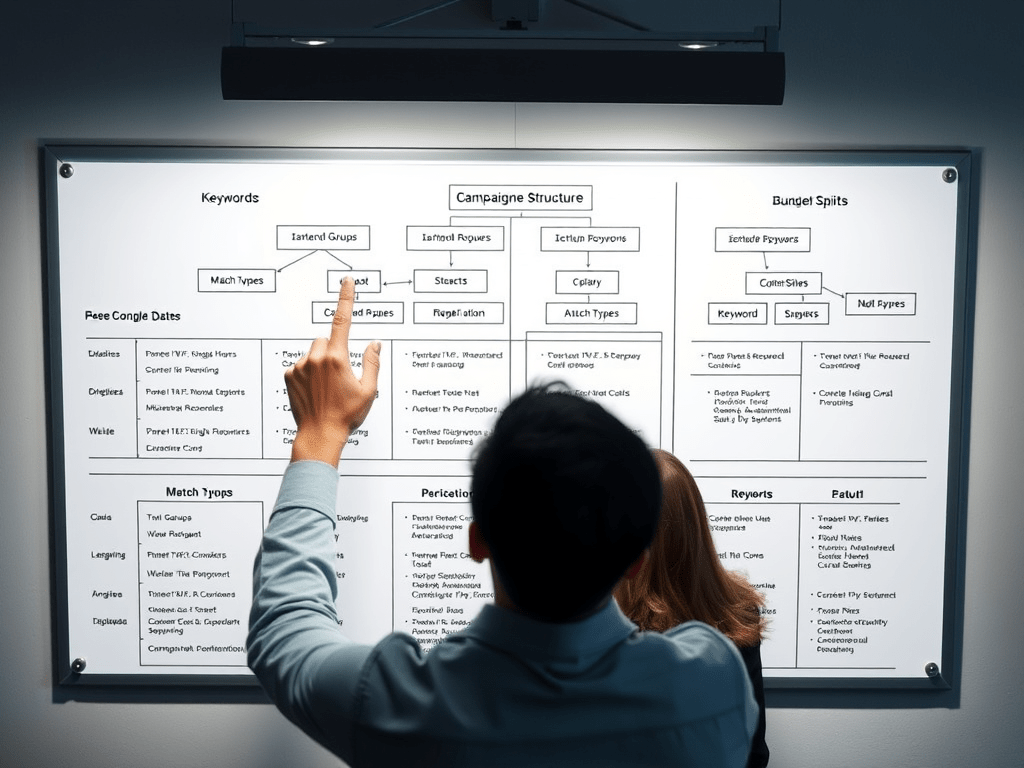
Over the years, I’ve rebuilt campaigns hundreds of times—sometimes because performance was bad, sometimes because the business changed, sometimes because Google did. What I’ve learned is that campaign structure is how you communicate with the algorithm.
I teach my team to think of structure as a language. If you throw 200 keywords in a broad match group and expect great results, you’re speaking gibberish to Google. But when you group tightly by intent, use clear naming conventions, and align ad copy with landing pages, the platform starts working with you.
We spend hours on:
- Keyword intent mapping
- Match type logic
- Geographic segmentation
- Budget priority by funnel stage
I have them build mock structures for fake clients. I give them goals (“Drive phone calls for a local HVAC company with a $3,000 budget”) and watch how they build. We then critique together.
One of my proudest moments was watching a junior hire completely restructure a campaign for a physical therapy clinic and reduce CPL by 35% in 3 weeks—just by aligning ad groups to pain-point-specific services and tightening radius targeting.

Optimization: The Leverage Mindset
Back in the early 2010s, I thought good optimization meant doing more. More bid adjustments. More split testing. More automation. But over time, I learned that great optimization is about doing the right things in the right order.
I teach a framework:
- Tier 1: Structural and tracking issues (fix before anything else)
- Tier 2: Strategic inputs (audience targeting, ad rotation, bidding)
- Tier 3: Creative tests (ad copy, LP variations, assets)
We do weekly “Top 3 Moves” reports. Each team member picks 3 things they changed, predicts the outcome, and follows up the next week. This builds strategic discipline and creates space for failure as part of learning.
I once had a team member run a winning experiment where they flipped a standard search campaign into a call-only campaign for a dentist client. Calls doubled. But what made it great was the write-up—they explained the business logic and the intent shift that justified the test.

Ads That Sell: Teaching Real Copywriting
When I started out as a web developer in the early 2000s, I didn’t consider myself a copywriter. But over time, I realized great ads come from understanding what the customer needs to hear—not just what we want to say.
I teach my team:
- To start every ad with the user’s problem
- To test specificity over cleverness
- To align ad tone with the landing page experience
I’ve seen bland ads win A/B tests when they spoke plainly and directly. “Got Knee Pain? Schedule Physical Therapy Today.” outperformed every clever variation in one campaign. I want my team to earn the click with clarity.
Every new hire goes through headline rewriting drills, user persona immersion, and direct response critique sessions. If it wouldn’t get someone to stop scrolling or take action in real life, it’s not good enough.

Reports That Clients Actually Read
I’ve sat in too many meetings where a smart specialist loses the client’s trust because they can’t connect platform data to business goals.
That’s why we train on reporting like it’s client strategy.
Every report:
- Leads with business metrics (revenue, calls, cost per lead)
- Includes visual summaries
- Offers three “insight + action” combos
- Uses clear, plain English—no jargon
We also add Loom videos. I want every PPC specialist comfortable walking a client through the why, not just the what.
It’s not just about retention. It’s about training specialists to own the business result, not just manage spend.

When They’re Ready—and What Comes Next
You know someone’s leveled up when they start catching issues before you do. When they suggest strategy changes based on lead quality, not just CPC trends. When they ask “what’s the LTV of this segment?” instead of “should we raise the budget?”
Even then, training never stops. We rotate who leads audits. We do teardown contests. We experiment with scripts, Performance Max nuances, and integrations with CRMs and call tracking platforms.
PPC is a moving target. But the fundamentals—empathy, clarity, structure, intent—don’t change.

Final Words
I’ve spent decades in the trenches—starting as a designer, then a developer, then an all-in-one marketing department for whoever would take a chance on me. Training PPC specialists to do great work is personal. I built my career on making small budgets drive big results, and I expect my team to learn that same grit, strategic clarity, and respect for the craft.
If you’re training people now—or being trained—my best advice is this:
Teach them to think like business owners. Train them to question their assumptions. Give them space to learn through accountability, not fear.
Google Ads is just a platform. But great specialists? They’re rare because they’re built.
And if you build them right, they’ll drive results that no AI or automation can replace.


 Marketing Unplugged
Leave a Reply