


Subliminal marketing refers to the use of subtle or subconscious messages in advertising and marketing campaigns. It is a technique that seeks to influence consumer behavior by planting suggestions below the threshold of conscious awareness. The origins of subliminal advertising can be traced back to the 1950s when a researcher claimed that subliminal messages in a movie theater could increase sales of popcorn and soda. Although the validity of this claim has been disputed, the concept of subliminal advertising has persisted and continues to be a controversial topic in the marketing world. In this blog post, we will explore the power of subliminal marketing by examining its history, real-life examples, ethical considerations, and future potential.
Examples of Subliminal Marketing
Subliminal marketing can take many forms, from visual cues and symbols to auditory messages and musical beats. Here are a few examples of subliminal advertising in action:
- Visual Cues: A famous example of visual subliminal advertising can be found in Stanley Kubrick’s film “The Shining”. In the movie, a subliminal image of the word “SEX” is embedded in a shot of the Overlook Hotel’s carpet.
- Backward Masking: This technique involves playing an audio message backward in a song, making it inaudible to the conscious mind but still perceived by the subconscious. Some advertisers have used this technique to plant positive or negative messages in popular music.
- Brand Placement: Subliminal messages can also be conveyed through product placement in movies and TV shows. This technique involves placing a particular brand in a prominent position, making it more likely to stick in the viewer’s mind.
- Color Psychology: The use of certain colors can also convey subliminal messages. For example, the color red is often associated with passion, excitement, and urgency, while blue is often associated with calmness, trust, and security. Advertisers use these associations to influence consumer behavior and evoke emotions.
These are just a few examples of subliminal marketing in action. In the next section, we will examine the ethical considerations surrounding this controversial technique.
1. PEPSI VS. COKE
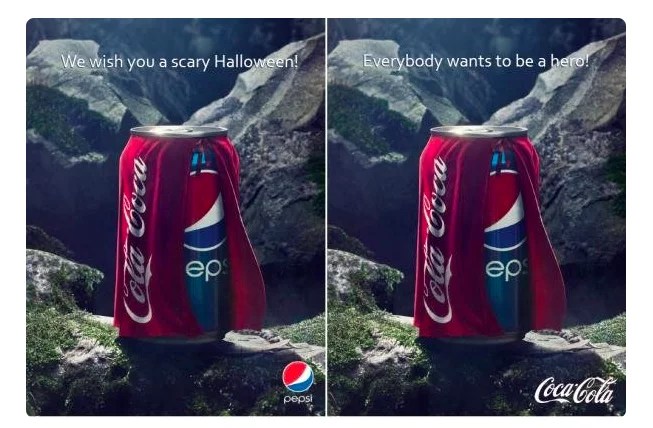
It’s subtle but effective.
Pepsi was the first to unveil the ad, playing up the “horror” of receiving a Coke when you really want a Pepsi.
Coke’s response was perhaps even better, capitalizing on the caped Coke as the real hero of the story.
Why it Works: It works so well because the two classic competitors each manage to make consumers see their product in a positive light – while casting a clear shadow on the competition.
It’s designed to make you feel something without explaining why, and it manages to do just that.
2. TOSTITOS
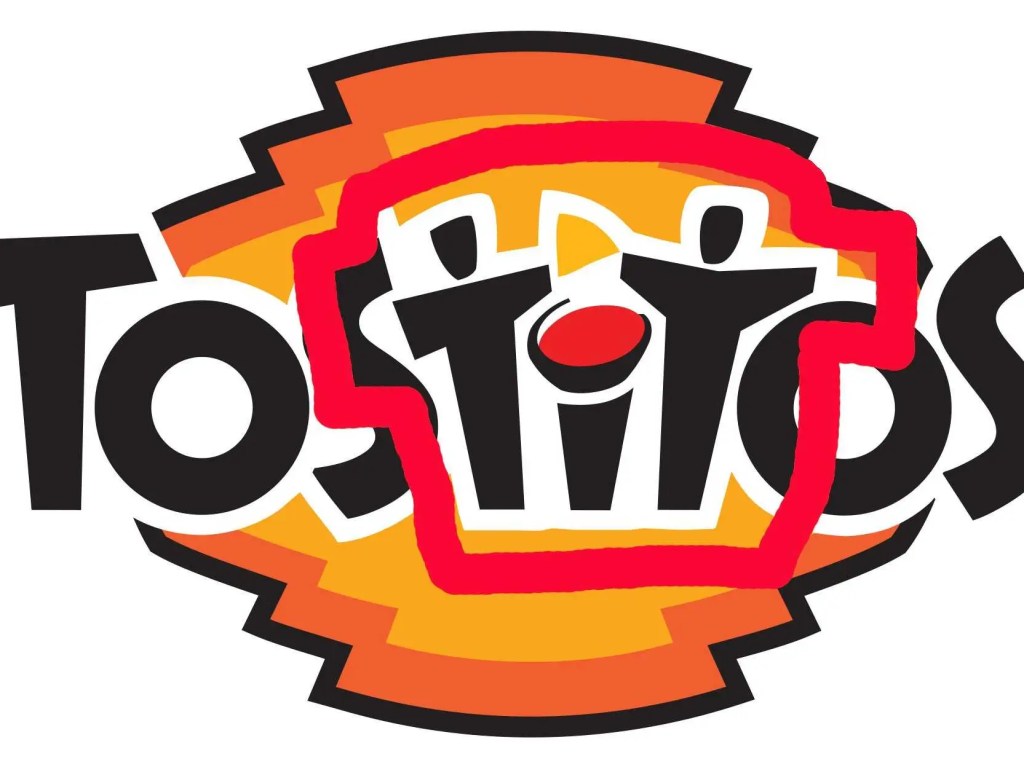
I’ll be honest, it took me years to notice this one.
The Tostitos logo is something almost all of us are familiar with, but unless you’ve taken the time to really inspect it, you probably missed the hidden scene in the middle.
The two T’s also form two friends sharing chips and salsa. Pretty cool, eh?
Why it Works: It works because it isn’t in your face, and it promotes the benefit of the brand. The message is so subtle, you likely never even consciously noticed the message before: Enjoy a tasty snack with people you like.
It isn’t pushing sales necessarily; instead, it’s pushing an experience.
3. AMAZON

Amazon has arguably one of the most recognized logos around.
But no matter how many times you’ve seen it, you may not have really taken it in.
Take a look at the strategically placed arrow to see what I mean.
Why it works: The hidden message here is simple: Amazon sells everything, from A to Z.
It helps, of course, that Amazon actually does sell everything. It’s not pushy or salesy, it just reinforces the channels, all-in-one model.
The fact the arrow also forms a smile doesn’t hurt, either.
4. SNOOTY PEACOCK
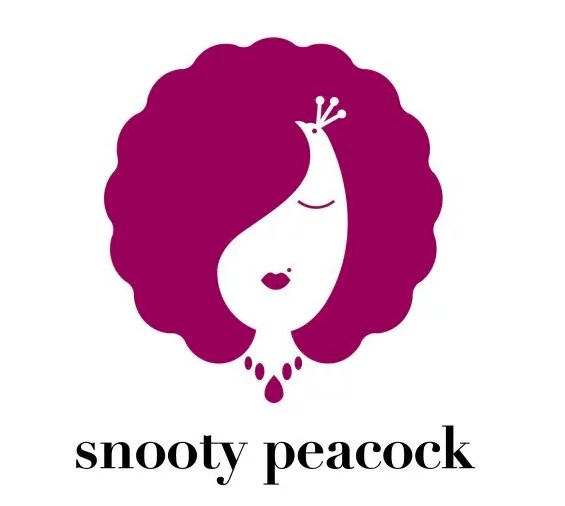
Sometimes, a subliminal message can be in your face and still work.
Case in point: the Snooty Peacock.
Why it works: The optical illusion used here delivers two images: one a peacock, the other a woman with a necklace.
Depending on how you look at it, you could see one or the other. Both, however, are intended to hint at the elegance of the brand.
Peacocks are prettier birds, often seen as decorative, while the woman represents the unique clientele. If you couldn’t tell, the Snooty Peacock is a jewelry manufacturer.
Once again, it’s not necessarily a sales tactic. But it will cause a viewer to look twice at the ad – which is exactly what the Snoot Peacock wants.
5. FEDEX
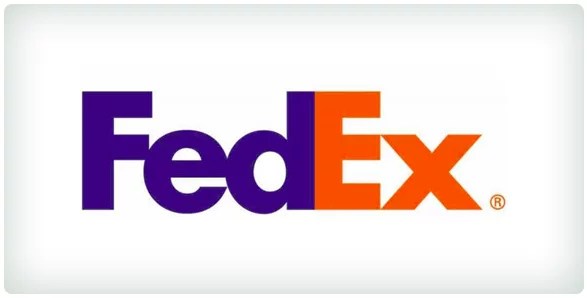
Here’s another one you probably didn’t see coming.
Even your friendly, neighborhood FedEx is harboring a hidden message. The whitespace between the E and X clearly outlines an arrow.
Why it works: FedEx uses the arrow to highlight speed and efficiency – the brand’s biggest benefits.
Like many others on the list, you wouldn’t know it until someone pointed it out. But once you do, you feel all the more clever about it.
6. SFX MAGAZINE

SFX Magazine is a sci-fi magazine that focuses on all things fantasy and sci-fi entertainment-related.
But you wouldn’t necessarily know it from the cover.
Many have noticed that the logo is often obscured to look like it’s spelling out something a little different – especially when women are featured on the cover.
Coincidence or intentional subliminal advertising?
Why it works: Well, it made you look, didn’t it?
7. PIRATES OF THE CARIBBEAN

Disney’s long been accused of hiding subliminal messages in their movies.
But this one may be the most subtle (and clean) of them all.
While not exactly obvious, a longer look has many convinced that Disney adapted the well-known skull and crossbones emblem to look more like their iconic Mickey Mouse logo.
Why it Works: People love Mickey Mouse. They feel good about Disney.
So present them with something that’s reminiscent of both, and they’re bound to transfer some of those good feelings – whether conscious of it or not.
Whether it was Disney’s intention or not to draw such a close similarity, there’s no denying the resemblance.
8. BASKIN ROBBINS
You’ve probably heard of Baskin Robbins. You might even know the company sells 31 flavors of ice cream.
But did you also know that Baskin Robbins uses subliminal advertising? In fact, the company used a subliminal message to promote the number of flavors it sells.
Check out the logo below. Look carefully at the non-blue part.
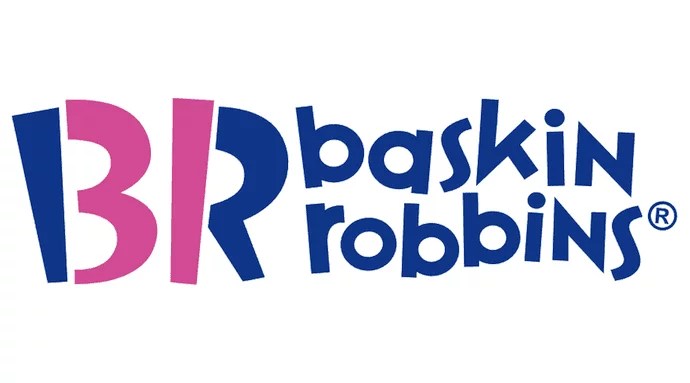
It’s subtle, but it gets the point across. There’s a distinct “31” within the “B” and the “R”.
The company uses that subliminal message to reinforce its well-known unique selling proposition: a whole lot of flavors to choose from.
9. TOYOTA
Have you ever looked closely at the Toyota logo? If so, you might have noticed a bit of subliminal advertising in it.
The logo looks like a fairly routine car company graphic. However, if you pay careful attention, you can see that the logo has meaning.
How so? Because the various parts of the graphic can spell out the word “Toyota.”
Take a look at the graphic to the left of the company name in the image below. See if you can make out letters within it.

You can create letters by hiding specific parts of the logo. Then, you can use the letter you create to spell out the brand name.
You can see how to do that with the image that follows.

See that? Different parts of the logo can create different letters.
Toyota uses that logo to reinforce its brand. It’s a very clever strategy.
10. TOBLERONE
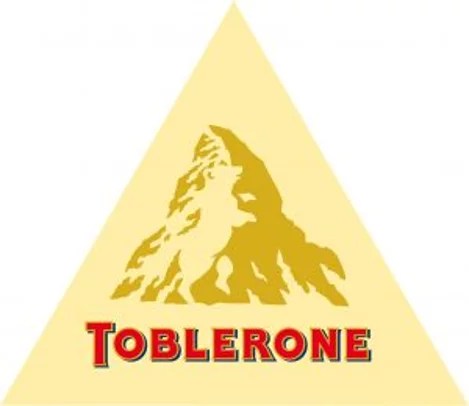
At first glance, the Toblerone logo looks like your average Swiss mountain range. But take a closer look and you’ll notice that the logo features a bear standing on its hind legs expertly hidden in the design.
Why it works: This is a clever tribute to the Swiss city of Bern, nicknamed “the city of bears,” where the chocolate company was founded.
11. NBC

While most are familiar with the NBC logo, there are a few subtle details that are easy to overlook. The white space in the middle combined with the rainbow colors around it creates the illusion of a peacock.
Why it works: This represents the company’s pride in the shows and programs they produce and broadcast.
Ethics of Subliminal Marketing
The use of subliminal advertising raises important ethical questions for marketers and consumers alike. Some of the key criticisms and concerns include:
- Manipulation: Critics argue that subliminal advertising manipulates consumers by influencing their behavior without their knowledge or consent. This can be seen as a violation of consumer autonomy and trust.
- Effectiveness: The validity of subliminal advertising as a technique is a matter of debate. Some studies have shown that subliminal messages have a measurable impact on consumer behavior, while others have shown no effect. This raises questions about the ethics of investing in an unproven technique.
- Regulations: There are currently few laws and regulations in place to regulate the use of subliminal advertising. This lack of oversight has led some to call for greater protections for consumers against subliminal marketing tactics.
- Responsibility: Advertisers and marketers have a responsibility to communicate openly and transparently with consumers. Subliminal advertising can be seen as a breach of that responsibility, as it seeks to influence consumer behavior in a way that is not immediately obvious.
Despite these criticisms, subliminal advertising continues to be used by marketers and advertisers. In the next section, we will explore the future potential of this controversial technique.
The Future of Subliminal Marketing
As technology continues to advance, the potential for subliminal advertising is likely to increase. Some of the key ways in which subliminal marketing may evolve in the future include:
- Virtual Reality: The rise of virtual reality technology presents new opportunities for subliminal marketing. Advertisers can use virtual environments to plant subliminal messages in a way that is even more immersive and convincing.
- Neural Marketing: As our understanding of the brain and human behavior improves, marketers may develop new techniques for subliminal advertising that are even more effective. This could include using brain scans and other tools to target specific areas of the brain with subliminal messages.
- Increased Regulation: As awareness of the power of subliminal advertising grows, there may be calls for increased regulation of this technique. This could include laws and regulations that protect consumers from subliminal messages or industry standards that encourage transparency and ethical practices.
These are just a few ways in which subliminal marketing may evolve in the future. Ultimately, the future of subliminal advertising will depend on the collective actions of marketers, consumers, and regulators.
In today’s modern digital marketing landscape
n today’s modern digital marketing landscape, subliminal marketing remains a relevant and often-used technique. With the rise of digital media and the increasing power of algorithms and data analytics, advertisers now have more tools than ever before to target and influence consumer behavior.
Subliminal marketing has adapted to the digital age through techniques such as native advertising, influencer marketing, and online product placement. These digital marketing strategies are designed to be subtle and subliminal, making it difficult for consumers to differentiate between paid advertising and genuine content.
Moreover, the use of AI and machine learning in digital marketing has increased the accuracy and precision of targeting, making subliminal marketing even more effective. However, with this increased power also comes increased responsibility. Advertisers must ensure that they use subliminal marketing techniques in an ethical and transparent manner, or risk losing the trust of consumers.
Overall, subliminal marketing continues to play a major role in the modern digital marketing landscape, presenting both opportunities and challenges for marketers and consumers alike.
Subliminal marketing has been a controversial and debated topic for many years. While some view it as a powerful tool for influencing consumer behavior, others see it as a manipulative and unethical practice. Regardless of one’s stance on subliminal advertising, it is clear that this technique has the potential to be highly effective.
As technology continues to advance and our understanding of the brain improves, the potential for subliminal advertising will only increase. This presents both opportunities and challenges for marketers, consumers, and regulators alike.
Ultimately, the impact of subliminal advertising on the advertising and marketing industry will depend on the choices we make as a society. By engaging in open and honest conversations about the power and potential of subliminal marketing, we can help ensure that this technique is used in a responsible and ethical way that serves the best interests of consumers and society as a whole.

 Marketing Unplugged
Leave a Reply